





DU
The digitalisation of child protection presents a major challenge for social and medico-social institutions and services.
Given the combination of regulatory constraints, diverse practices and on-the-ground realities, setting up a suitable information system requires a gradual and collaborative approach. Through AVVEJ’s experience, discover how a structured project, combining tools and support, can help embed digital practices in a sustainable way for the benefit of professionals and service users.
Digitising child protection: a collective challenge
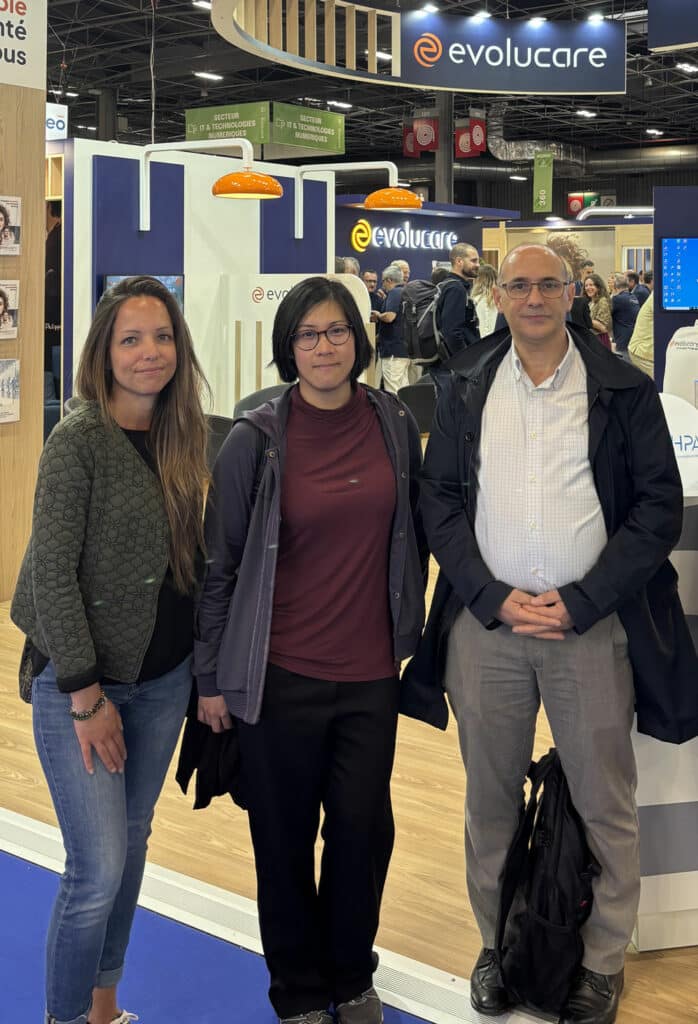
At SANTEXPO, several professionals from the AVVEJ association are sharing their experiences of implementing a unified information system.
The digital transformation of the medical and social care sector is gathering pace, driven by the challenges set out in the Ségur Digital Plan and growing expectations regarding the quality of care. However, in the field of child protection (PDE), this momentum is coming up against particularly complex realities on the ground.
Their accounts illustrate a firm conviction: digitising child protection cannot be achieved without a collective approach, rooted in the practices and realities of the field.
Pictured :
- Morgane Pina, Executive Secretary at La Passerelle
- Bich Thuy DOAN, IT Project Manager
- Wajih Bourezg, Director of Les Amandiers and La Marelle
A sector with many facets, still undergoing digital transformation
Child protection is characterised by a wide variety of settings and practices: open care settings, MECS, SESSAD, emergency care facilities and parenting centres. Each of these services addresses specific needs, with different approaches to support.
In this context, setting up a shared information system presents a real challenge. Professionals must contend with:
- large volumes of cases
- outreach work
- administrative situations that can sometimes be complex
- a wide range of timeframes for support
Digital transformation must therefore adapt to these constraints, without making them more rigid.
Harmonising without standardising: a key challenge for organisations
For multi-site organisations such as AVVEJ, one of the primary objectives is to standardise practices whilst respecting the specific characteristics of each facility.
The introduction of a computerised user record enables:
- organise information
- secure data
- facilitate sharing amongst professionals
However, this harmonisation cannot be imposed from the top down. It relies on a gradual approach to change management, involving the teams and taking into account their level of digital maturity.
The success of the project therefore depends on striking a balance between a common framework and flexibility in its application.
Taking ownership of the tools: a key factor
One of the key lessons learnt from the field relates to professionals’ adoption of these tools.
In some organisations, which are still very much attached to paper-based practices, the introduction of software can meet with resistance: fears of complexity, concerns about confidentiality, or the perception that it will create an additional administrative burden.
Conversely, other organisations are quick to adopt these tools, particularly when they recognise the added value they bring on a day-to-day basis:
- greater clarity regarding situations
- centralisation of information
- time saved in data transfer
This disparity highlights the importance of local support, combining a formation, communication interne et relais terrain.
Different uses depending on the type of support provided
Feedback also shows that the ways in which the information system is used vary significantly depending on the type of activity.
In open-access settings, professionals favour simple, quick-to-access features, suited to one-off interventions and a high volume of cases.
In MECS, needs focus more on the traceability of events and the coordination of teams in complex situations.
In SESSAD, the more structured monitoring allows for a more in-depth use of case files and indicators, particularly within a more medicalised setting.
This diversity of uses confirms that a relevant tool is, above all, an adaptable one, capable of responding to different business requirements.
Data-driven management: a driver of transformation
Beyond operational uses, digitalisation opens up new possibilities in terms of management.
One of the AVVEJ’s objectives is to rely more heavily on data to support the management of its activities. Ultimately, the use of data will enable management teams to:
- monitor activity indicators in greater detail
- objectify practices
- identify areas for improvement
- facilitate decision-making based on consolidated and reliable information
This management capability, provided by Evolucare Analytics, will strengthen the autonomy of care homes and contribute to better decision-making.
The initial benefits are already evident: several reports and dashboards are already being requested and used by management teams to monitor specific indicators and gain a more precise overview of their operations.
As usage expands, these tools will also become a key driver of buy-in, demonstrating their value at both an operational and strategic level.
Ensuring safe use: a key requirement in child protection
In a sector where data is particularly sensitive, the issue of security is paramount.
Professionals express a strong need to work in a controlled environment that guarantees:
- the confidentiality of information
- compliance with regulatory requirements
- the traceability of access and actions
This requirement also extends to new applications, particularly those involving artificial intelligence.
Integrating support tools such as InacIA directly into the information system makes it possible to address these challenges, whilst avoiding the need to rely on external solutions over which we have no control.
It thus provides a secure framework for:
- facilitating the drafting of documents
- summarising information
- improving communication
Whilst leaving professionals in charge of their own decisions.
A success that is, above all, down to the people involved
Whilst tools play a key role in shaping the process, feedback from the teams highlights a crucial point: the success of a digitalisation project depends, above all, on the commitment of those involved.
Several factors appear to be crucial:
- clear and structured leadership
- designated points of contact within the organisations
- regular communication
- support provided as close to the front line as possible
This collective dynamic enables practices to be transformed gradually, without disruption.
Towards digitalisation rooted in the realities on the ground
LAVVEJ’s experience illustrates a pragmatic approach to digital transformation in child protection.
Far from a standardised approach, it is based on:
- listening to the needs of the sector
- adapting tools
- jointly developing ways of using them
It demonstrates that even in a complex sector such as child protection, digital solutions can be integrated effectively, provided they are designed with and for professionals.
Digitising child protection is a collective challenge that goes beyond the purely technological dimension.
Above all, it is about creating the conditions for appropriate and widely accepted use, for the benefit of professionals and service users.
From this perspective, tools such as Imago come into their own when they form part of a comprehensive approach that combines:
- adaptation to the realities on the ground
- support for teams
- continuous improvement of practices
Digital transformation then becomes a practical means of enhancing the quality of support, whilst respecting the specific characteristics of the sector.
Current challenges in child protection
Child protection relies on a wide variety of practices and structures, tailored to situations that are often complex. This diversity makes it difficult to establish common tools and shared standards.
The sector also remains in a phase of digital transition, with usage patterns that are still uneven and, in some cases, heavily reliant on paper. Added to this are regulatory constraints that do not always reflect the realities on the ground, particularly in emergency situations or contexts of unconditional care.
In this context, structuring data and improving coordination between stakeholders are becoming key priorities for enhancing the quality of support, whilst ensuring the security of information.
Regulatory framework (France)
Act No. 2002-2 of 2 January 2002 provides a fundamental framework for social and medico-social care homes. It strengthens users’ rights, notably by affirming their right to personalised support, to participate in their life plans, and to have their dignity respected.
AVVEJ is an organisation based in the Île-de-France region dedicated to child protection, supporting children, young people and families through a range of services: open-access centres, ITEPs, MECS, SESSADs, emergency accommodation and maternal and parental support centres.
Its work is based on an approach tailored to each individual situation, closely aligned with the needs of those it supports.