


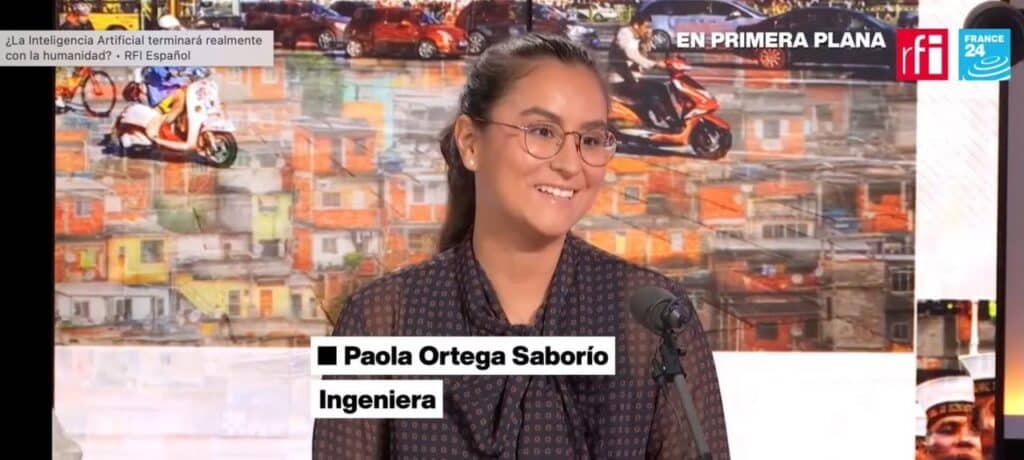
On 9 October 2026, RFI / France 24’s Spanish-language programme “En Primera Plana” posed a deliberately provocative question: is AI really going to kill us all? Appearing as a guest, Paola Ortega Saborío, an AI engineer at Evolucare, offered a clear-eyed perspective on artificial intelligence, particularly in healthcare.
Four experts tackle a complex subject
Hosted by Carlos Herranz, with editorial coordination by Florencia Valdés Andino, the programme brought together four experts:
- Paola Ortega Saborío, AI engineer at Evolucare, a French software provider for hospitals and clinics;
- Jules Treuille, artificial intelligence specialist at the French National Research Institute for Sustainable Development (IRD);
- Virginie Martins de Nobrega, lawyer and legal adviser specialising in AI;
- Oliver Hijano Cubelos, research engineer in biotechnology.
The debate on AI often pits two camps against each other: those sounding the alarm, and those who believe these fears are overstated, or even fuelled by the industry’s giants. The guests aimed to move beyond this divide.
“Between those sounding the alarm and those who see the concerns as exaggerated in ways that could benefit the industry’s major players, there is a lot to untangle. That is exactly what we tried to do, with nuance and without scaremongering.” – Paola Ortega Saborío, AI Engineer, Evolucare
Very real risks in healthcare
As the discussion unfolded, the panel turned to a particularly sensitive area: the arrival of increasingly powerful AI systems in healthcare. In this sector, an algorithmic failure means more than a drop in a performance metric: it can directly affect a patient’s care.

Systems must be designed for their context
An AI system reflects the choices made during its design: the data used to train it, its decision thresholds and its place in the workflow. A tool that is reliable in a test environment may prove unsuitable in practice if it was not designed with the realities of care teams’ work in mind.
Over-reliance: an underestimated risk
The second pitfall lies in how AI is used. By relying too heavily on the technology, professionals may see their own expertise erode. This phenomenon, known as “deskilling”, is beginning to be measured. A study published in 2025 in The Lancet Gastroenterology & Hepatology, conducted at four Polish endoscopy centres, found that endoscopists accustomed to using a tool to help detect polyps detected fewer adenomas when working without it: their detection rate fell from 28.4% to 22.4%. The authors call for training to be adapted to preserve these clinical skills.
Useful AI requires effective oversight
For Paola, the challenge is not to choose between adopting or rejecting AI in healthcare, but to design systems capable of keeping their own risks in check.
Keeping people in control
AI should inform professionals’ decisions, not replace them. This is also the approach taken by the European framework: Regulation (EU) 2024/1689 on artificial intelligence classifies AI systems integrated into medical devices as high-risk systems, subject to human oversight requirements.
Preserving professional expertise
Paola also stressed a key point: entrusting everything to AI means losing the knowledge needed to spot its mistakes. Healthcare professionals must be able to practise without the tool and know how to challenge it.

Each person brought a different perspective: technical, legal or scientific. This is the kind of multidisciplinary debate we need on these issues.
Bringing disciplines together
The panel’s composition reflected this approach: an engineer specialising in AI for healthcare, an AI researcher, a legal expert and a biotechnology researcher.
Innovating with rigour
This ambition goes hand in hand with another value, excellence: applying professional expertise to achieve the highest quality. Paola’s contribution to an international broadcast illustrates this approach: addressing AI with rigour, without giving in to either blind enthusiasm or fear.
At Evolucare, innovation, particularly AI, is one of our five founding values. It supports our ambition to become a pan-European leader in digital healthcare services, supporting a continuum of care that connects healthcare and social care.
👉 Learn more about Paola’s appearance on the program “En Primera Plana” on RFI / France 24.
Paola Ortega Saborío is an AI engineer at Evolucare, specialising in natural language processing (NLP) applied to healthcare. She holds a master’s degree in Data and Artificial Intelligence from Institut Polytechnique de Paris and a bachelor’s degree in Computer Science from the University of Costa Rica. Her work focuses on turning clinical and care-related text into actionable information to support healthcare professionals.